Εμφάνιση αναρτήσεων με ετικέτα Articles in English Language. Εμφάνιση όλων των αναρτήσεων

Παρασκευή 22 Νοεμβρίου 2019

Utopian obsessions of a Professor


Για ελληνικά:


By Yannis Tsiamitros

We are surprised to see the serious Professor’s late interest in ‘Vlachica’ (Aromanian/Vlach number of linguistic idioms). Now that you have closed your sixties, dear professor, it has come to your mind to be the leader of a group to save ‘Vlachica’? Who told you that ‘Vlachica’ was banned by the state (in Greece)? Nobody forbids anyone to speak it. If you go to Metsovo, you will find out (you already know) that everyone speaks it both in family and in public. No one has banned it from doing scientific work, doctoral theses, conferences, etc, here in Greece. Much work has been done on ‘Vlachica’ during recent decades, and no body, neither state nor institutional etc, has been against it. So, you are not the only one to be the leader of a group or as a person for such a purpose, for the first time, nor you and your group do make up any particular 'sparkles of life on a beautiful tree'.

It's really interesting to see you being involved with this subject, it raises our interest and it really doesn’t make us get bored. However, we are impressed by your interest in 'breaking' (not you) Balkan peoples into ethnic groups, more ethnicities, differences, minorities, etc. But, doesn't this kind of 'breaking' weaken the Balkan states and doesn’t help economic and political Great Powers of Europe and World exploit their (of Balkan peoples) natural resources? Aren’t all these situations against our nation, which may make our weak State not even now ‘stand on its feet’? Don't we have borders and don't we know it? Don't we have a state? Dear professor, don't you want a nation-state? Say it straight! But, that's the way things are around the world today. Isn’t it better for us to say that the Greek language, the mother of all languages, is the one which is in danger? After all, if we ‘dig deeper’, Latin language (‘grandmother’ of ‘Vlachica’) comes from Greek language. Believe me, sir, I am neither a ‘nationalist’, nor an extreme, nor evil, nor 'toxic' - a word familiar to you. Of course, I don’t consider you a nation-‘nihilist’ (/εθνομηδενιστής/ in Greek), or anything like that, all these things are far away of my concern.

Πέμπτη 21 Δεκεμβρίου 2017

Aromanian Anthroponymy


Thessaloniki, ancient roman ruins
~ Για ελληνικά:

The appearance of Aromanians [1], Latin-speaking ones, Vlachs [2], known more widely as Koutsovlachs [3], in north Greece territories dates back to the Roman conquest. This fact has been recognized by distinguished and special Romanian scientists such as Vasile Pârvan, Radu Vulpe, Gheorghe Brătianu [6], Take Papahagi [7], Emile Petrovici [8], Şextil Puşcariu [9] and Dumitru Maniu [10] eventually great Th. Capidan [11] has recognized it, too. Latey, not only Aromanians’ indigenousness but their greekness have been proved after interdisciplinary converging elements, too [12]. Competent Greek scientists have already accepted (the theory) of direct or indirect linguistic enlatinization of Greek people, while a similar possibility was earlier excluded because of the superiority of Greek culture over the Roman one [14]. It is well known that Romans, before being rulers of Greek territories, had sought to establish friendly relations with Greek cities and federations [15]. When they conquered Greece [16], not having the necessary manpower to govern the new countries, they first addressed to the ruling class of Greeks to use it for the state administration, the army and other levels of state and social life. At the same time they used every Greek element [17]. Besides, Greeks of all classes did not mean to abandon their numerous activities, in particular commerce [18], exploitation of transport means [19], execution of public works, etc. The social rise of Greek urban (mainly) class in Roman Empire was indeed significant, given the fact that Greeks became senators, others occupied the office of Roman Supreme and many of them became senior military and imperial administrative officers [20]. At the same time, Greeks of lower classes, people of mountains and lowlands, were the inexhaustible source of the manning of roman legions [21], where they distinguished themselves or at least they secured better living conditions.

Greeks took care on time to obtain the title of Roman citizen [22] because this title offered special privileges and it favored social development and proficiency without obstacles in trade and other profitable professions. Indicatively, we give a few examples:
From the island of Kos, brothers Gaius Stertinius Xenophon (doctor and secretary of Emperor Claudius) and Tiberius Claudius Cleonimus (military officer of Roman army). From the town of Mytilene Marcus Pompeius Macrinus (roman supreme). From the town of Ephesus Tiberius Julius Celsus Polemius, supreme, his son Tiberius Julius Akylas Polemius, also supreme, who founded the famous library in his hometown. From the town of Nicomedia, the well-known writer Flavius Arrianus, provincial governor and supreme. From the city of Pergamon, the history writer Avlos Claudius Harax, commander of roman legion and supreme. From the island of Limnos the well-known writer Flavius Philostratus, whose son was called Lucius Flavius Capitoleinus. From the island of Crete, Lefkius Flavius Sulpikianus (Dorion Polyknis), senator. From the town of Sparta Gaius Julius Euriklis, cashier, mayor, general and senator. From Athens, Marcus Ulpius Eviotis, supreme, and his sons Marcus Ulpius Flavius Tisamenus and Marcus Ulpius Pupinius Maximus. Also Herod Atticus, whose full name is Tiberius Claudius Herod Atticus Marathonius. From the town of Megara Komodos Komodou. From the island Amorgos Aurelius Octavius, Aurelius Ermeus’ son. Plutarch's nephew, stoic philosopher and Marcus Aurelius’ teacher, Sextus, and others. Consequently, as Ioannis Touloumacus also writes, “from the presence of Greeks in the Senate, the administration and the army of the Empire, one would also expect cultural influences - and of course, first of all in language. All Greek officers of the Roman Empire knew latin language pretty much, some even so good as to read latin classic writers comfortably, too. In fact, Latin was known by almost all Greek intellectuals of the Roman era, from Polybius and Posidonius (during the period of liberty) to Plutarch and Philostratus, during the imperial period [23]”.

Κυριακή 3 Δεκεμβρίου 2017

What Romanian sources testify about the musical style of Vlachs (Aromanians)


Avdella, 1906 - Αβδέλλα, 1906 
What Romanian sources testify about the musical style of Vlachs (Aromanians)

Tache Papahagi (linguist, ethnologist, folklorist, song collector in Romania), in the course of his research in his book, entitled ‘Poezia Lirica populara’ (lyric folk poetry), Bucharest, 1967, admits (inter alia) that: "when you hear the melodies of Aromanian/Vlach songs, you will lead to the conclusion that Aromanian/Vlach folk poetry has Greek origin".

G. Markou from Romania in his work, entitled ‘Folklore Muzical Aroman’ (Aromanian/Vlachic Musical Folklore), Bucharest, 1977, points out (inter alia) that: ‘Aromanians/Vlachs dance in rhythms, the names of which have Greek origin (sirtos, singastos, karapatakis, tsiamikos)’.

Paunescu, a Romanian folklorist, investigating Aromanians/Vlachs of Interwar, who settled in the annexed, disputed (by Bulgarians) Dobruja of South Romania, was suddenly surprised when, asking their wives to sing vlachic songs, he heard a crystal clear Greek song.

Translated in English by Yannis Tsiamitros, English teacher.
Source: here

Τι μαρτυρούν οι ρουμανικές πηγές για το μουσικό ύφος των βλαχόφωνων:

Ο Tache Papahagi (γλωσσολόγος, εθνολόγος, λαογράφος, συλλέκτης τραγουδιών στην Ρουμανία) στην πορεία της έρευνάς του στο βιβλίο ‘Poezia Lirica populara’ (λυρική λαϊκή ποίηση), Βουκουρέστι 1967, παραδέχεται μεταξύ άλλων ότι: «όταν ακούσει κανείς τις μελωδίες των αρμάνικων-βλάχικων τραγουδιών θα οδηγηθεί στο συμπέρασμα ότι η αρμάνικη δημώδης ποίηση έχει προέλευση και καταγωγή ελληνική».

Linguistic 'Enlatinization' of Greeks & Genesis of Vlachs (Aromanians) by Achilles Lazarou


Translated in English by Yannis Tsiamitros, English teacher.

Literary sources defend the ‘enlatinization’ of Greeks or with another expression, the genesis of Vlachs/Aromanians, too. For example, Ioannis Lydos’ [19] famous testimony, which Romanian E. Lazovan, professor of Copenhagen Univercity, strongly supports, rejecting unacceptable scientific behaviors of other Romanians, especially scientists from Romanian Academy, who try hard to shrink the range of (previous) historical testimony or to falsify it in ‘cold blood’. First of them is I. I. Russu [21], who shows misinterpretation (in his works) in the past. The second one, H. Mihaescu [22], is also the one who hides the word ‘Greek’ (Έλληνας) systematically, because this word overturns completely the Romanian propaganda that Aromanians/Vlachs until Nafpaktos and Tainaros (south Greece) are Romanians!

Written sources of linguistic enlatinization of Greek people, however, are aboundant. Inscriptions from Thesally, Ipirus and Macedonia make up a material that really illuminates and impresses. L. Lafoscade [23], G. Bratianu [24]. Br. Helly [25], Μ. Hatzopoulos, etc, studied them and ascertained (linguistic) enlatinization, bilingualism and genesis of Vlachs of Greek origin in the above areas [26]. The last one (M. Ηatzopoulos) right in Veria (town) locates indications of the beginning of the Aromanian, the vlachic idiom (of Latin origin), based on a Christian inscription of 5th century in Latin language [27].

So, the former notorious ‘principle’, according which one language does not enter another language of higher culture, already weakened during the interwar period after F. Lot’s comments of [28], is now cluttering [29]. At the same time, the objections (beliefs), according which the spread of Latin (language) supposedly presupposes a non-Greek linguistic and ethnological background, are completely outdated and unfounded. Because Greekness of northern Greek comes true scientifically and in many ways nowadays after the findings of well-known scientists like Hammond, Papazoglou [32], Kalleris [33], Poghirc etc. In particular, the latter with his PhD thesis, approved by the Univercity of Leningrad-St Petersburg, proves the Greekness of the ancient Macedonian (language) and its users, taking also into consideration the international lead in Kalleri’s special research [34], as well as the existence of all the agents of (linguistic) enlatinization of northern Greece [35].

Source: Αχιλλεύς Γ. Λαζάρου, Ελληνισμός & Λαοί Νοτιοανατολικής (ΝΑ) Ευρώπης, Τόμος Β', Αθήνα 2009, σελ. 254-257. (Achilles G. Lazarou, ‘Hellenism and Peoples of Southeast Europe’ (SE), Vol. II, Athens, 2009, pp. 254-257, here)

Το πρωτότυπο κείμενο στα ελληνικά:

Πέμπτη 30 Νοεμβρίου 2017

Μιλώντας για τον Βλαχόφωνο Ελληνισμό - Speaking of Aromanian-speaking Hellenism


Γράφει ο Γιάννης Τσιαμήτρος

O συγγραφέας Αναστάσιος Ν. Τσικώτης στο βιβλίο του ‘Μιλώντας για το Βλαχόφωνο Ελληνισμό’ στις σελ.123-24 γράφει:
Α. Βακαλόπουλος, που μας πληροφορεί ότι, πρώτος ο αείμνηστος Πισοδερίτης λόγιος Σωκράτης Λιάκος αντιλήφθηκε την μεγάλη σημασία της περικοπής αυτής του Ι. Λυδού (σημείωση δική μου σχετικά με την περικοπή: στα μέσα του 6ου μ.Χ αιώνα οι κάτοικοι της Βαλκανικής, μολονότι στη πλειοψηφία τους ήταν Έλληνες, μιλούσαν την ιταλική γλώσσα και κυρίως όσοι ήταν κρατικοί υπάλληλοι), διατυπώνει την αξιόλογη παρατήρηση ότι η φράση «και μάλιστα τους δημοσιεύοντας» υποδηλώνει ότι πλην των «δημοσιευόντων», δηλαδή των κρατικών υπαλλήλων, και άλλοι κάτοικοι «εφθέγγοντο τη των Ιταλών φωνήν». «Τι απέγιναν αυτοί οι λατινόγλωσσοι ή οι δίγλωσσοι;» διερωτάται ο Βακαλόπουλος. «Εξηφανίσθησαν χωρίς να αφήσουν κανένα ίχνος; Η πρόδηλος, μου φαίνεται, απάντηση στο ερώτημα συμβάλλει στη λύση του προβλήματος της καταγωγής των Βλάχων»].

Μετάφραση στα Αγγλικά:

Writer Anastasios N. Tsikiotis writes in his book (pp. 123-24), entitled ‘Speaking of Aromanian-speaking Hellenism':
Apostolos Vakalopoulos (top modern Greek historian) informs us that the first one, who realized the great importance of this text quotation by I. Lydos (clarification on this text quotation: in the middle of 6th century BC the inhabitants of Balkan peninsula, although they were mostly Greeks, they spoke the Italian language and mainly those who were state employees), was late scholar Socrates Liakos from greek village Pisoderi. 
So, A. Vakalopoulos makes the remarkable observation that the phrase of the above text quotation (‘μάλιστα τους δημοσιεύοντας’ =mainly those who were state employees) suggests that, except these state officials (‘δημοσιεύοντας’), there were also other inhabitants who spoke the Italian ‘voice’. ‘What happened to these (other) Latin speakers or bilingual people?’, Vakalopoulos wonders. ‘Did they disappear without leaving a trace?’ ‘It seems to me that the obvious answer to the above question contributes to the solution of the problem of the origin of the Vlachs/Aromanians’, he concludes.

Δευτέρα 6 Νοεμβρίου 2017

Nikolaos and Eugenia Kiki


Kiki’s legacy in Mihailova avenue
~ Για ελληνικά: 

Nikolaos P. Kikis was a Greek merchant. Born in 1797 in vlach-speaking Kleisoura (known also as Vlacho-Kleisoura) of Kastoria, wherefrom he emigrated to Belgrade, where in 1832 he started a goods warehouse. He was occupied with the trade of rice and, later, of tobacco. He was supplied with tobacco by the Romanian and Russian monopoly. He had in his name a cigarette factory in Odessa, which he kept till the First World War. Initially he was married to the daughter of Duke Pesik and later to the daughter of the also Greek Vlach Hatzi Tzortze Petrovic, a merchant from Besenovo. D. Popovic underlines that, he was always close to the Greeks, and that, whenever he was in Belgrade, he was helping and protecting especially the poor originating from Kleisoura, i.e. the same village as he.

Nikolaos D. Kikis was born in Kleisoura on 1841. He emigrated to Belgrade where, in the beginning, under the guidance of his uncle engaged successfully in commercial activities and managed to surpass his mentor. The couple Nikolaos and Eugenia Kiki provided the funds to build a grand hospital in Belgrade, on avenue Mihailova number 50, which was donated to suffering Serb and Greek merchants.

Δευτέρα 26 Ιουνίου 2017

Influence of Ancient Greek to Aromanian regarding the numeral system


~ Για ελληνικά: 

Translation from Greek to English by Tsiamitros Ioannis, graduate of the Aristotle Univercity of Thessaloniki (Greece), Faculty of Philosophy, School of English language and literature.

It is well confirmed that there is a linguistic relationship between Greek and Ar(o)manian (Koutsovlahic*). Prominent Greek scientists have recently (last forty years) dealt with this issue [Nikos Katsanis, Antonis Bousboukis, Kostas Dinas (linguists) and Achilles Lazarou (balkanologist-romanist)] and came to such scientific conclusions. We hope that, after more attentive and proper research, additional secure conclusions will be in the future.

In this present note we will deal with the influence of Greek to Ar(o)manian regarding the numeral system. All information was taken a) by N. Katsanis’- K. Dinas’ book, entitled 'Γραμματική της Κοινής Kουτσοβλαχικής’ (Grammar of Common Ar(o)manian), edited by ‘The Archives of Ar(o)manian Studies’, Thessaloniki 1990 and b) by Achilles Lazarou's book, titled ‘Βαλκάνια και Bλάχοι’ (Balkans and Ar(o)manians), edited by ‘Φιλολογικός Σύλλογος Παρνασσός’ (Parnassos Philological Association), Αthens 1993.

In the above mentioned first book, N. Katsanis and K. Dinas tell us (pp. 67-68, notes 1-3) the following, word for word (verbatim):
Note 1. “…Numbers (numeral system) of Ar(o)manian differ with the corresponding ones of Dako Romanian considerably. Greek cardinal numbers are often used in Ar(o)manian after no 10, while the use of Greek ordinal numbers is even wider’’.
Note 2. “Numbering from no 1 to no 19 in Ar(o)manian is not Latin-like, although the elements, that are used, are Latin. We find similar numbering in Albanian, Slavic and ancient Greek, where no 11 and no 12 are treated as ἓνδεκα (eleven), δώδεκα (twelve) [δέκα (ten), εἷς, (one), δύο (two)]. From no 13 onwards, the identification of ancient Greek and Ar(o)manian is absolute: Anc. Greek: three and ten (τρεις και δέκα) = Ar(o)m.: trei sprădzatsi, Anc. Greek: four and ten (τέταρες και δέκα) Ar(o)m.: patru sprădzatsi, Anc. Greek: five and ten (πέντε και δέκα), seven and ten (επτά και δέκα) etc’’.
Note 3. “Ar(o)manian, as far as no 20 concerned, is different from Dako Romanian, which ignores Latin VIGINTI and uses doauazece (DUO DECEM). Ar(o)manian from no 21 to no 29 follows numbering similar to ancient Greek. So, no 21 in ancient Greek is: εἷς και εἴκοσιν, in Ar(o)manian is: unspraγingits (UNUM SUPRA VINGITI), while in Dako Romanian it is douazeci si unu (twenty and one)…”.

Let us now see the relevant extract of the above mentioned second book (‘Βαλκάνια και Βλάχοι’, by A. Lazarou) on pages 218-219.
"... The numeral system of Ar(o)manian, especially from number 20 onwards, is of great evidential (influence of ancient Greek to Ar(o)manian) importance as well. There is verified correspondence of the Ar(o)manian numeral system to the ancient Greek one, more accurately that one of popular (δημώδης) ancient Greek. It is considered the oldest type of system, as Schwyzer etc remark. Although the numerical terms (words) both in Ar(o)manian and Romanian are Latin, (the way of) numbering differs impressively. A small confrontation (of examples) makes the difference clear as following:

Latin
20 = viginti
21 = viginti unus, a, um (or unus, a, um et viginti)
22 = viginti duo, duae (or duo, duae, duo et viginti)
23 = viginti tres, tria (or tres, tria et viginti) etc.

Τετάρτη 3 Μαΐου 2017

The verb of the Aromanian language, by Antonis Bousboukis


CONCLUSION
First extract (p. 177) of PhD in linguistics, titled’ The Verb of the Aromanian (language), by Antonis Bousboukis, Athens, 1982.

[…The Aromanian verb was strongly influenced by the Greek verb in many morphological elements, as seen in the second part. The most powerful effect, however, is observed at the semantic-syntactic level of the verb. This is an eloquent testimony that Aromanian/Vlach was profoundly ingrained by the Greek way of thinking. Thus, the semantic-syntactic functions of the all tenses remind (us) of the corresponding uses of the Greek verb. Simple Past (tense), for example, is so often used that it substitutes Present Perfect (tense) in many cases. This reminds (us) of its corresponding use in Greek language (p.75), while the Romanian language and the other Romance languages ​​use Present Perfect more frequently. Besides, the statement of a future act by Simple Present (p.62) instead of Simple Future is much rarer in Aromanian, as it is in Greek, unlike the other Romance languages.
The mood ​​of the Aromanian verb bears even stronger the stamp of Greek influence. The frequent use of the Subjunctive (mood), for example, which substituted the Infinitive (form of a verb), is result of the influence of the Greek verb (p.85). On the other hand, other Romance languages, as well as the Romanian (one), in part, preserve the use of the Infinitive. The statement of probability and possibility even with the Indicative (mood) instead of the usual Subjunctive (p.86-87) is also a result of Greek influence…]

CONCLUSION
Second extract (p. 183) of PhD in linguistics, titled’ ‘The Verb of the Aromanian (language)’, by Antonis Bousboukis, Athens, 1982.

[… Latin elements of the Aromanian concerning terms of agricultural and pastoral life (103), which do not appear in the Romanian, recommend a further indication of the formation of the Aromanian, parallel and-geographically-independent of the Romanian.
Katsanis (104) also finds matches of the Aromanian with the Tsakonian (Greek dialect), matches that ‘are phonetic, morphological and lexical. The first (phonetic) are the most frequent, while morphological and lexical ones are not that much’.
The same researcher assumes that ‘these language idioms must continue and preserve older linguistic elements, common once in the Greek world’.
All the above, along with the archaic lexical loans of the Aromanian, borrowed by the Greek (105), converge to the ascertainment that the Aromanian consists an independent branch of the Romance language in the Balkans…].

Πέμπτη 6 Απριλίου 2017

The Political Side of the Kutzovlach Affair Revisited


One wonders whether most Greeks nowadays are cognizant of the fact that according to the highly respected U.S. Library of Congress the Vlachic Hellenism is considered as a '(Roumanian) ethnic minority' in the Hellenic Republic!

[Please refer to the INTRODUCTION DEMOGRAPHY ethnic minorities Thessaly and Languages]

In the meantime, the Turkish foreign ministry, during a period of assumed détente with Greece, appears to maintain a keen academic interest in this matter (as evidenced by the infamous "dossier on the Vlachs", including among other things, Professor Tom J. Winnifrith's ethnographic maps )!


It is in the context of this precarious political background that the semi-official European Bureau for Lesser Used Languages (EBLUL) envisages the reappraisal and delineation of an "(ethno)linguistic Vlach minority" in Greece. 

On 11-14 November, 2002 a ''closed door'' EBLUL meeting took place in Thessaloniki with about 40 participants. The minutes of the conference can be found in http://www.eblul.org/pajenn.asp?ID=91&yezh=saozneg

It is noteworthy that the elected presidents of the two principal Vlach Greek organizations, "Panellhnias Omospondias Blaxwn" kai ths "Enwshs Blaxwn Episthmonwn", who were not initially invited, were finally allowed to attend the meeting. However, their request to have their dissenting views recorded in the official minutes was not granted. 

The official response of the elected Vlach Greek leadership was recently posted in the web site of Epirus News 
[see Archives/Arxeio Sat/Sun 16-17 November, 2002] 
[Please note that the text is in Greek. If your PC cannot recognize Greek fonts I will be happy to send you the text in 'latinized Greek' upon request. The text was not translated into English at this time in order to preserve the 'original language' of the official document.] 

Τρίτη 21 Μαρτίου 2017

The Vlach Dimension of Modern Hellenism: A Critical Reappraisal


An interview with Dr. Christos D. Katsetos* regarding Vlach Hellenism, broadcasted at “The Voice of Greece” on ERA5, on the 14th of May in 2005. 
We are republishing an excerpt as a very small token of our appreciation and gratitude to this brilliant Medical Doctor, Academic Teacher and Intellectual, who left this world yesterday, breaking our hearts. 
His deep love towards Hellenism and us in particular, the Vlachs, a love that imbues all his writings on modern Greek identity will always be a shining example for all of us to follow. 
Farewell dear Professor.

....Since Monastir, Krushevo and other towns and villages were one time flourishing centers of Vlach Hellenism of Pelagonia, the part of Macedonia that fell to Serbian occupation and is now part of FYROM, what became of the Vlach descendants today?

As mentioned earlier, the Vlachs are autochthonous inhabitants of Macedonia (including the Pelagonia region) who fought for the preservation of Greek culture and education during the long Ottoman years and the Balkan wars. Despite having been subjected to unrelenting Roumanian propaganda since the last quarter of the 19th century, and also despite having suffered unprecedented slaying and ruin in the hands of Bulgarian 'komitadjis', in the early part of the 20th century, the Vlachs stood steadfastly on the Greek side. The Vlachs financed schools, churches, and infirmaries and kept the Greek spirit alive in Macedonia.

At this juncture, I should like to underscore the long tradition of Vlach merchants in the building of schools and churches in Macedonian market towns and the Diaspora. Quoting from the book of Kriste Pitoski "The churches and schools of the town of Monastir in the mid- 19th century were in Greek hands". According to the memorandum submitted to the Rumanian government in 1901 by Lecanda Lazarescu, head of propaganda: "In villages where the population consists entirely of Vlachs, the Greek schools are packed with pupils while the Romanian schools stand empty. The Vlachs contribute to the running of the Greek schools and, when they die, leave their fortunes to the cause of disseminating Greek education". This is how the multilingual Greeks-Romioi of Monastir (Bitola) defined themselves in the dawn of the 20th century: ''Λαλουμεν ελληνιστί, βουλγαριστί, βλαχιστί, αλβανιστί, ομως απαντες ειμαστε Ελληνες και δεν επιτρεπουμε σε κανεναν να μας αμφισβητει τουτο'' ("We speak Greek, Slavonic, Vlach, Albanian but we are all Hellenes and we do not allow anyone to dispute this fact").

It is noteworthy that today, FYROM does not recognize the existence of a Greek minority in the region of Pelagonia, claiming only the existence of a vestigial Vlach-speaking minority. The Greek State has closed the chapter of Pelagonia since the signing of the Bucharest Treaty in 1913 by Eleftherios Venizelos. In the face of Greek indifference AND inertia, Skopje has played an old (19th century) card of political manipulation, exploiting historical communal divisions between the pro-Roumanian and pro-Greek Vlachs.

The interest on the part of FYROM nationalists to assimilate the Vlachs is twofold: firstly, to extinguish any claims for a Greek minority in FYROM, and secondly, to ensure that the 'Macedonian Slavs' constitute a majority in that country.

Σάββατο 18 Μαρτίου 2017

What language was mostly spoken in ancient Rome?


It was Greek, not Latin

A lingua franca is a language used between two people when neither is using their mother tongue. Rome was the capital city of a fast and expanding empire, a commercial hub of over a million people. 

Although the native Language of Rome (capital of Latium) was Latin, the lingua franca -the language you would use if you were buying or selling or generally trying to make yourself understood was koine or 'common' Greek. 
Greek was also the language of choice for Rome's educated urban elit. Sophisticated Romans saw themselves as the inheritors of Greek culture. Virgil's Aeneid -the epic poem that tells the story of Rome's foundation- makes it explicit that contemporary Rome grew directly out of the mythical Greece that Homer had written about. Speaking Greek at home was essential. Most of the literature that upper-class Romans read was in Greek; the art, architecture, horticulture, cookery and fashion they admired was Greek; and most of their teachers and domestic staff were Greeks. 

Even when they did speak Latin it wasn't the classical Latin that we recognise. For speaking native Romans used a form of the language called 'Vulgar Latin'. The word vurgar simply meant 'common' or 'of the people'. Classical Latin was the written language -used for law, oratory and administration but not for conversation. It was the everyday version that the Roman army carried across Europe and it was Vulgar, not classical Latin that spawned the Romance languages: Italian, French and Spanish.

Σάββατο 29 Οκτωβρίου 2016

Educational and economic activities in the Greek community of Koritsa during the second half of the nineteenth century


Koritsa
Adelais Ismirliadou

In the second half of the nineteenth century Koritsa developed into one of the major urban centres in the Balkans. Under the Turks it was part of the vilayet of Monastir and was the capital of the sanjak of the same name.
The town of the kaza of Koritsa was the seat of a Greek Orthodox Métropolite and a Turkish mutessarif. According to the French traveller Pouqueville, who visited the city in 1805, there were 1.300 families living in Koritsa two thirds of which were Christian. Around 1875, the city had 8.200 inhabitants, and by 1905 the population had reached 18.000, 14.000 of whom were Greek and 4.000 Albanian. The Christians were concentrated in the “Varossi” district (1.250 households) and the Moslems in “Kasaba”[1].
The inhabitants of both the city of Koritsa and the surrounding area spoke Greek and Albanian as well. As in most of Epirus, Strabon’s words applied here too: “The race of Epirots was ever bilingual”. The customs and traditions of the Greek community in the city, the greetings, the banqueting ceremonies, and the style of dress and footwear were much closer to the Epirot than to the Macedonian customs[2]. Like all religious or ethnic communities in the Ottoman Empire, after the publication of the Hatt-i Humayun charter of 1856, the Greek Christian community of Koritsa, “in accordance with the age of enlightenment and civilisation”, and with the Patriarch as its civil and religious leader[3], was granted the right to set up a council and run its own ecclesiastical and ethnic affairs according to local customs and needs. The relevan provisions, needless to say, operated within the framework of Ottoman legislation and the General Regulations of the Patriarchate[4]. The specific provisions were ratified in 1862 under the title “General Regulations for the Arrangement of the Ecclesiastical and Ethnic Affairs of His Majesty the Sultan’s Orthodox Christian Subjects under the Ecumenical Throne” and were in force until 1923, when they were abolished by the Treaty of Lausanne[5]. The “General Regulations for the Common Institutions of the City of Koritsa” were based on this principle. The acts were ratified (reg. No. 5041) by Ioakeim III, Patriarch of Constantinople, in 1876. Meanwhile, on 5 November 1875, the Metropolitan of Koritsa, Dorotheos Christidis, had convened a general meeting of the citizens of Koritsa to elect a ten-member committee, with which he worked out some general provisions for the running of the community. According to the regulations, the council of elders formed the nucleus of the city; it was presided over by the Métropolite and had eight members, who enjoyed the confidence of the community and were elected at a general meeting[6].
One clear indication of the inhabitants’ strong religious faith was the magnificent churches in the city, the many smaller churches in the surrounding countryside, and the numerous monasteries. The churches included the cathedral[7] —dedicated to the Source of Life, St Haralambos, and St Bessarion— the Churches of St George, Virgin, St Andrew, St John, and St Nicholas, and the country Churches of St Athanasius and Prophet Elijah.
The economic life of the Greeks of Koritsa was rich and varied. They mainly engaged in horticulture, viticulture, stock-breeding, bread-making, blacksmithery, tanning, dyeing, clockmaking, and goldsmithery, and there was a strong local tradition of carpet-, rug-, and sandal-making. Another major occupation was the building. Highly skilled builders travelled all over Epirus and beyond, constructing buildings both public and private. Such was their fame, indeed, that Epirot builders went by the general name of Koritsalides[8]. Just outside the Monastir entrance to the city there were also two lime-kilns, the older of which had been built by Athanassios Kalfas in 1870. The ornamentation of the city was largely due to the existence of these two kilns. The surrounding mountains were rich in minerals and high-quality coal, and the red marble of Polena was renowned. Anthracite from the Morava Valley powered the local light industry, the lime-kilns, and the steam mill[9].

Κυριακή 15 Μαΐου 2016

Gopesh - The Hellenic Association "Elpis"


From the membership records of the community of Gopesh in 1920, p. 30:

Benefactors of the Hellenic Association of Gopesh, Elpis” (Hope)

The organization of our compatriots in America: … (the names of the Greek-Vlach emigres from Gopesh and the exact sum of money that was sent as a donation) >
~~~~~~~~

Gopesh along with the entire region of Pelagonia became part of the Kingdom of 
Serbs, Croats and Slovenes. Nowadays it's part of FYROM

Below you can see the records along with the registries in question

Σάββατο 26 Μαρτίου 2016

"Anagennesis". A Renaissance of the Hellenic Psyche Is Well Overdue - Marcus A. Templar


"Anagennesis". 
A Renaissance of the Hellenic Psyche Is Well Overdue.

By Marcus A. Templar, March 23, 2016. 


It is common sense for a country (regardless of the political ideology of its people) to unite on issues of importance regarding national security and national interests. Political divisions are expected, but, to my knowledge, in no other country in the world do domestic political quarrels transcend common sense to the point of stupidity as in Greece. It seems as though the national goal of the ‪Greek people is the obliteration of Greece. Local political divides should and must stop at the borders of the country! 
‬‬‬‬‬‬‬‬‬‬‬
Because foreign policy encompasses a country’s national security and its national interests, it should be national, cohesive, and coherent, with all parties adhering to it. International law based on diplomatic instruments affects domestic policies and legislation and, of course, the life of the citizens of a country. Such important documents usually do not see the light of day in the Greek Parliament. In my view, the most important document of modern Greece that has hit the heart of Greece’s national security and territorial integrity – the 1995 Interim Agreement between Greece and the FYROM – in violation of Article 28 of the Constitution was bypassed and never ratified by the Parliament. To my knowledge, not one politician of any party yelled, “Foul.” The Constitution provides for ministerial decisions only when referring to secondary rules of law or administrative matters such as recruitment, dismissal, promotion, transfer agents, definition guarantees, etc. These are simply executive decisions. But the Parliament must ratify treaties, conventions and such! 

Every single political party has had its own ideas on how to save the country by essentially staying on the sidelines and using emotion and ideology instead of knowledge, experience, and critical thinking. By remaining on the sidelines, the Greeks have allowed others to write the rules, leaving the Greek people to swallow the excuse: “We are a small country; the great powers write the rules!”

No party should monopolize Greece’s foreign policy! 

We pride ourselves on the fact that we gave ‪Democracy‬ to the world. Although I agree that this is the case, I would argue that we never kept that idea for ourselves. Demagoguery, anarchy, personal attacks are not part of democracy; they are part of the chaos‬‬‬‬‬‬‬‬‬‬‬‬‬, and it is why Greece has not only failed: she has defeated herself! ‬‬‬

Σάββατο 19 Μαρτίου 2016

The Impact of Germans in the East


Klaus Johannis
The incumbent President of Romania
~ Για ελληνικά:

2009/10/16
SIBIU/BUKAREST (Own report) - The chairman of one of the "Germandom" organizations in the German foreign policy network is the focus of a Rumanian government crisis. The Rumanian opposition wants to name the mayor of Sibiu, Klaus Johannis, to fill the vacancy left by the prime minister, who was toppled by the opposition at the beginning of the week. Rumanian President, Traian Băsescu has rejected this plan and nominated a financial expert for prime minister. Johannis heads the "Democratic Forum of Germans in Rumania" (DFDR), an associated member of the "Federal Union of European Nationalities" (FUEN), which from its headquarters in Northern Germany also coordinates Europe's German language minorities - with government support. The FUEN, founded by former Nazi racists, is working with Johannis as well as with Germany's Hermann Niermann Foundation, which was the target of large protests in Eastern Belgium, because of its covert lobbying efforts for "Germandom" organizations. Johannis' nomination is the second exceptional step taken in behalf of Rumanian "Germandom" within a week. The first was the awarding of the Nobel Prize in Literature to a "Rumanian German" author.

The Rumanian opposition parties, which toppled the Prime Minister with a no-confidence vote at the beginning of the week, have nominated the current mayor of Sibiu ("Hermannstadt"), Klaus Johannis, to fill the post of transitional prime minister. Rumanian President, Traian Băsescu has rejected this intention and named the financial expert, Lucian Croitoru, to be the new prime minister. Croitoru would have to be confirmed by parliament, which seems very unlikely, because the opposition has a majority and insists on its candidate, Johannis. The outcome is open.

Ethnic Policy
Klaus Johannis comes from the Rumanian "Germandom" milieu, to which he attests such secondary virtues "as correctness, reliability, pragmatism and efficiency."[1] He is the chairman of the local "Germandom" organization, the "Democratic Forum of Germans in Rumania" (DFDR), which, like many other associations of German language minorities in Eastern and Southeastern Europe, was founded in the immediate aftermath of the upheavals in 1989. The DFDR, like its chairman, Johannis, is closely associated with the networks of "Germandom" spread all over Europe. The DFDR is an associated member of the "Federal Union of European Nationalities" (FUEN), an organization, bringing together numerous European and Central Asian minorities, founded along the lines of the traditional German ethnic policy in the aftermath of World War II by ex-Nazi racists.[2] Within the FUEN, the DFDR, is also a member organization of the "Working Group of German Minorities" (AGDM), that stands in constant contact with the German Interior Ministry.[3] The party of Rumania's Hungarian speaking minority, the Uniunea Democrată Maghiară din România (UDMR) is also a FUEN member *. It is one of the parliamentary parties proposing Johannis for the post of prime minister.

Τρίτη 19 Ιανουαρίου 2016

Σχέσεις Μοσχοπόλεως και Αγίου Όρους - Relations between Moschopolis and Mount Athos


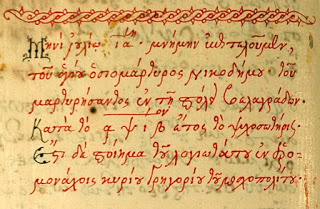
Ακολουθία Οσιομάρτυρος Νικοδήμου.
Έργο Γρηγορίου Μοσχοπολίτου
Παταπίου μοναχοῦ Καυσοκαλυβίτου

Σχέσεις Μοσχοπόλεως καί Ἁγίου Ὄρους *
Οἱ περιπτώσεις τοῦ Βίου τοῦ ὁσιομάρτυρος Νικοδήμου καί τοῦ ἔργου τῶν ζωγράφων Κωνσταντίνου καί Ἀθανασίου ἀπό τήν Κορυτσᾶ καί Δαβίδ ἀπό τή Σελενίτζα

Οἱ σχέσεις μεταξύ Μοσχοπόλεως καί Ἁγίου Ὄρους θά μποροῦσαν νά ἀναχθοῦν στό πρῶτο μισό τοῦ 17ου αἰ., μέ τήν ἵδρυση στά περίχωρα τῆς ἔνδοξης αὐτῆς βορειοηπειρωτικῆς πόλης, τῆς μονῆς τοῦ Τιμίου Προδρόμου[1]. Τό ἀρχαιότερο σωζόμενο μνημεῖο τῆς Μοσχοπόλεως, τό καθολικό τῆς μονῆς Προδρόμου (ἀνέγερση 1632, εἰκονογράφηση 1659)[2], εἶναι ἀθωνικοῦ τύπου, καθώς εἶναι σταυροειδής ἐγγεγραμμένος μέ τρούλο ναός καί μέ πλάγιες κόγχες (χορούς). Ἀνήκει ὅμως σέ σύνθετη παραλλαγή τοῦ ἀθωνικοῦ τύπου, ὅπου τό ἱερό Βῆμα ξεχωρίζει ἀπό τή σταυροειδή δομή, μέσω δύο πεσσῶν[3]. Παράλληλα, μελετώντας κανείς τά σωζόμενα τμήματα τοῦ κώδικα τῆς μονῆς Προδρόμου[4], διαπιστώνει ἕνα βαθμό ἐπιρρεασμοῦ τοῦ ἐκκλησιαστικοῦ Τυπικοῦ τῆς μονῆς ἀπό τό λεγόμενο «ἀθωνικό τυπικό».

Ἐπιπροσθέτως, στήν περίφημη Νέα Ἀκαδημία τῆς Μοσχοπόλεως, τό λαμπρότερο ἐκπαιδευτικό ἵδρυμα ἀνώτερης παιδείας στό βαλκανικό χῶρο στά μέσα τοῦ 18ου αἰώνα (λειτούργησε τήν περίοδο 1740-1769)[5], διακρίθηκε ἕνας ἀπό τούς ἀξιολογότερους σχολάρχες της, ὁ λαμπρός λόγιος ἱερέας Θεόδωρος Καβαλλιώτης (1718;-1789)[6], πού στάθηκε ἐπί τριετία μαθητής τοῦ Εὐγένιου Βούλγαρη, σχολάρχου τῆς Ἀθωνιάδος Σχολῆς τοῦ Ἁγίου Ὄρους τήν περίοδο 1753-1759. Τό 1760, ἐξάλλου, φαίνεται ὅτι συνδιδάσκαλος μέ τόν Θεόδωρο Καβαλλιώτη ὑπῆρξε ἕνας ἀπό τούς ἀποφοίτους τῆς Ἀθωνιάδος Σχολῆς· ὁ ἱερομόναχος Κωνσταντῖνος[7].

Ὁ ἁγιορείτης λόγιος Εὐλόγιος Κουρίλας Λαυριώτης, μητροπολίτης Κορυτσᾶς, ἀναφέρει γιά τούς καθηγητές τῆς σχολῆς αὐτῆς: «Οἱ διάφοροι αὐτοί διδάσκαλοι τοῦ Γένους καί περιφανεῖς λόγιοι, μέ τήν ἀκαδημαϊκή τους διδασκαλία καί τίς συγγραφές τους ἀναζωογόνησαν τόσο πολύ τόν ἑλληνισμό καί ἀνύψωσαν τό ἐθνικό φρόνημα, ὥστε κατέστησαν ἀθάνατο τό ὄνομα τῆς Μοσχοπόλεως»[8].

Θά πρέπει ἐπίσης νά σημειωθεῖ ὅτι πολλές ἀπό τίς ἀσματικές Ἀκολουθίες πού ἐκδόθηκαν ἀπό τό Τυπογραφεῖο τῆς Μοσχοπόλεως, βρίσκονται σέ ἀρκετά ἁγιορειτικά χειρόγραφα. Ὁρισμένα ἀπό τά χειρόγραφα αὐτά ἀπετέλεσαν πηγή γιά τίς μοσχοπολίτικες ἐκδόσεις ἐνῶ ἄλλα εἶναι ἀντίγραφά τους. Χαρακτηριστικά ἀναφέρουμε τόν κώδ. Βατοπεδίου 1134, ὅπου βρίσκουμε δύο κανόνες (σέ ἤχους δ΄ καί πλ. δ΄) πρός τόν ἅγιο Κλήμη ἀρχιεπίσκοπο Βουλγαρίας, πού συνέθεσε ὁ Δ. Χωματιανός[9], τόν κώδ. Ἁγ. Παντελεήμονος 505, φ. 6β, μέ ὑμνογραφήματα πρός τούς «Ἁγίους Πέντε καί Δέκα ἱερομάρτυρες, τούς ἐπί Ἰουλιανοῦ τοῦ Παραβάτου μαρτυρήσαντας ἐν Τιβεριουπόλει»[10], τόν κώδ. Δοχειαρίου 198, τοῦ ἔτους 1509, διά χειρός Μαξίμου τοῦ Βατοπεδινοῦ, μέ τήν Ἀκολουθία τοῦ ἁγίου ἱερομάρτυρος Ἐράσμου «τοῦ ἐν τῇ Χερμελίᾳ τῶν Ἀχριδῶν»[11]. Ἐπίδης, στόν κώδ. Ἰβήρων 889[12] ὑπάρχει «Πρόχειρον Ἐγχειρίδιον παντοτινοῦ σεληνοδρομίου» τοῦ ἱερολογιωτάτου κυρίου Βελισσαρίου τοῦ πρωτοσυγγέλου τῆς Μεγάλης τοῦ Χριστοῦ Ἐκκλησίας, καινῷ τύπῳ ἐκδεδομένον· δαπάνῃ τοῦ μακαριωτάτου ἀρχιεπισκόπου Ἀχριδῶν κυρίου κυρίου Ἰωάσαφ, ἐπιμελείᾳ δέ τοῦ κυρίου Μιχαήλ Γκόρας. Ἐν Μοσχοπόλει ᾳψμα΄ παρά Γρηγορίῳ ἱερομονάχῳ τῷ Κωνσταντινίδῃ». Στόν παραπάνω κώδικα, ἀντίγραφο τοῦ ὁμώνυμου βιβλίου πού τυπώθηκε τό 1741 στό τυπογραφεῖο τῆς Μοσχοπόλεως[13] ἀναγνωρίζουμε τόν χαρακτηριστικό τύπο τοῦ τυπογραφείου αὐτοῦ.

Τρίτη 29 Δεκεμβρίου 2015

Oliver Njego

Για ελληνικά: Oliver Njego

Oliver Njego is a Serbian operatic baritone, who also crossed over into popular music, eventually becoming one of the most respected and most famous Serbian opera singers. 

He was born in 19-9-1959 in Nis, Serbia. He grew up with two influential parents, who endowed him with the necessary education and moral values that defined his adult life and work. His father, Đokan, originated from Herzegovina and was a pilot. His mother, Darinka, hailed from a wealthy Greek Cincar family of doctors from Monastiri (modern day Bitola). She was a Stomatologist, Pharmacist and University Professor who later directed the well-known Pharmaceutical Industry “Alkaloida”.

He graduated in 1990, at the Faculty of Music Art in Belgrade in the class of Professor Radmila Bakočević. In 1991 becomes the member of National Theatre in Belgrade opera department, where he performed in Gioachino Rossini's The Barber of Seville, Donizetti's L'elisir d'amore, and many other famous operas. He has won three major awards at the competition Belgrade Spring, and won many prizes in various cultural events throughout the country and the world. Until now, he has performed in China, United Arab Emirates, France, Italy, Korea, Great Britain, Hungary, FYROM, and many other countries. 

With his godfather Predrag Miletić, actor of the National Theater, he has traveled for several years in a row with a bike to the monastery Hilandar on Mount Athos in Greece. Their journey was published in the book Biciklom do Hilandara by Predrag Miletić.

Σάββατο 28 Νοεμβρίου 2015

The Greek Behind Bulgari - interview


Sotirios Voulgaris (1857-1932) was the Greek creator of Bulgari, one of the world's most famous jewellery brands today.

Born in the Greek village of Kalarites in March of 1857, Sotirios began his career as a jeweller in his home village of Paramythia (Epirus, Greece), his parents were George Voulgaris and Eleni Strougari.

Of the eleven children of the family, Sotiris Voulgaris was the only one who survived and managed to continue the family tradition. The passion with jewellery started from his grandfather Constantine, who was a street vendor in the villages of Epirus. The talent to create jewellery was inherited by Sotiris, who along with his father opened a jewellery shop in Paramythia.

At that time, Paramythia and other villages in the region were facing problems from the Turks. Continuous burning of the village and serious damage to the shop, forced the Bulgari family to move to Corfu and then to Naples, Italy.

In Naples, the family opened their first GOLD jewellery shop. The city crime posed a major problem for their valuable jewellery. So, after several burglaries, they were forced to close.

In 1881, Sotirios Voulgaris and his family moved to Rome. Three years later, in 1884, he founded his company and opened his second shop in Via Sistina. The store in Via Sistina was then replaced by the current flagship store in Via dei Condotti opened in 1905 by Bulgari with the help of his two sons, Constantino (1889–1973) and Giorgio (1890–1966).

After Giorgio's death in 1966, his son Gianni led the company as co-chief executive with his cousin Marina. As chairman and CEO of Bulgari in the early 1970s. Bulgari opened its first international locations in New York City, Paris, Geneva, and Monte Carlo in the 1970s. 

Δευτέρα 12 Οκτωβρίου 2015

Borislav Pekić: From an attic to the stars


By Jovo Anđić

There are people who left their trail imprinted with the printing colour on brittle paper. They are the creatures of arts, the people with gift that only those ready to perfect their mastery get and those trying to elevate life. Their human duration is just a drop in the ocean of eternity; their masterpiece supersedes time and shines like a star even when they cease to exist.

We’ll start the story of Borislav Pekić, one of them, at a Pannonian plain farm, in an attic of his grandmother’s home in the village of Bavanište, at the time when he, as an eleven-year-old researcher discovered a treasure chest. But the treasure that he found in the chest with a rusted frame, a kind of across-the-ocean travel case, is not of ordinary kind. This one included: the dates of birth, marriage and death, joyful and sad events recorded in birth certificates, marriage certificates, records, family documents, and memories: a handful of clippings from newspapers, letters, daguerreotypes, and a gallery of unknown men and women and faraway cities, a whole mysterious world that would spark his imagination. Many years later, he admitted that there, on the lost continent, his Atlantis, he had experienced adventures that would not be surpassed by anything in terms of excitement, and that with the breaking of the case he had started his transgressive career of a novelist. That discovery affected his career more, he wrote, than reading Dostoevsky. As if the spirit of the past was then released, that had seized him and forced him to collect old newspapers, magazines, almanacs, letters, documents, and even receipts and prescriptions, and to make his home a kind of a tomb, where, he didn’t hide that, he felt the liveliest.